A. Bookworm was born in Reading, Pennsylvania, son of B. A. Bookworm and Ima (Reeder) Bookworm. Ima was the daughter of Oral Reeder and Bea (Lector) Reeder. Bea was the daughter of Merry (Binder) Lector. The family does not speak of Bea's father, Hannibal Lector. It's a Grimm story.

Wednesday, March 25, 2026

A Call to Action

 This blog post is intended for my friends and fellow bloggers in the book-reading and reviewing community.  This article is a must-read: The New Republic: "Nonfiction Publishing, Under Threat, is More Important than Ever" .

Newspapers that had book-review sections are dropping them.  Nonfiction, never easy to get published (by my personal experience and that of others I know), is becoming even more difficult.  And this is happening when documented facts, well-conducted and well-sourced research, and accurate information are needed more than ever.

 Those of us who blog about books, who review them, who look to each other for suggestions for good nonfiction reading, are now on the front lines of the fight to preserve what the article calls "long facts" in this age of misinformation, disinformation, and just plain ignorant nonsense.

I haven't blogged lately because of family concerns.  Hopefully, some of these matters will be resolved soon, so I can return more frequently to the blogiverse.  This matter is so important to the life of the United States as a functioning democracy that I am calling this matter to your attention.

We need to keep on blogging about books and reviewing them.  But how can our blogs receive wider dissemination?  I'm not on Facebook anymore.  When Mark Zuckerberg fired his fact-checkers and threw out anything resembling DEI, I could not stand it anymore, and I left.  Substack is a possibility.  BlueSky is an alternative, but unfortunately, a pale one at this time.  It needs more participants.  Or we could form a consortium of book bloggers similar to Geneabloggers (if you're familiar with that), and get a presence on Facebook, Substack, BlueSky, and wherever else.  But that takes more work than I am capable of right now.  2026 has not been kind to me: 2 friends have died, one a very dear and close friend who was also a cousin.  The IRS is on our backs saying we owe $2000 more in taxes, which I disagree with and have hired an accounting firm to challenge.   And our daughter's cancer, after three years of remission, has "reasserted itself aggressively," in her oncologist's words.  The stress is just too much for me to take on any new projects, but I will help in whatever way I can.  Is anyone willing -- and by "anyone" I mean more than one, because one person cannot handle such an enterprise alone -- to at least entertain the notion of a book-blogging consortium?  Can we at least discuss it?

At any rate, we need to keep blogging.  Our blogs are now more important than ever.


Sunday, February 8, 2026

Sunday Salon: Is there a sports fan in the family?

I can't say I come from a long line of sports fans, but, inspired by Sunday's Super Bowl LX broadcast, I'm going to talk about sports and my family for this week's Sunday Salon.  I don't know whether my father followed any sports, because he died about two weeks after my seventh birthday.  

I have a very fragmentary memory of attending a game in the Rose Bowl in Pasadena, California, with my mother and father and my uncle, dad's brother, and his wife.  What I remember most is that I really did not see much of the game, because it was apparently exciting enough that people kept standing up, and what I saw most was their backsides!  I was five or six, and I didn't know a thing about football.

My mother was a football fan, and she shared that enthusiasm with our next door neighbor on London Road, Mrs. Baker, on the south side of Jacksonville, Florida.  They would gather either at our house or our neighbor's house and watch the games on Sunday.  

My brother was on his high school football team and track team, but other than that, I don't know that he particularly followed any sports.  I don't much remember him at home watching games.  In our neighborhood, we had our own sports.  We were a motley crew playing basketball in a neighbor's driveway, with participants ranging in age from six to nineteen, and in stature from three or four feet to over six feet.  I also played baseball with other friends, usually a small game in the street, or "flyers 'n' grounders" with a friend.

In summer in the 1950s, I would go over to my grandmother's house, in the next block from our house, and we would watch baseball.  I latched onto the Brooklyn Dodgers -- yes, they were still in Brooklyn at the time -- as my team, and they have been ever since.  

When I was in high school, I would often attend games, and enjoyed watching my friends on the team play, and also enjoyed the social contact at the games.  I was a member of the "intellectual elite" of the school, and a bunch of us would gather at the games and make up pseudo-erudite cheers:  "Progress!  Progress!  Ambulate over the turf!"  And such as that.  We enjoyed the word play; other students looked at us like we were weird.  Which we were.

Football at my college in the 1960s was a very big deal.  Florida State University had a great team and a great coach, Bobby Bowden.  My boyfriend (who became my husband in 1971) and I attended many FSU home games.  At one game, it rained and rained.  Despite having on our London Fog raincoats, we were eventually drenched to the skin! 

I married a sports fan.  He enjoys watching football, baseball, tennis, the Olympics, and auto racing.  I have shared that enjoyment with him.  We used to like watching golf, but since the PGA made some decisions we consider questionable, we have dropped golf from our watchlists.  One day, for his birthday, I bought tickets to a rugby game at the University of North Florida in Jacksonville, where I was a student at the time, having gone back to college at the age of 60.  The game was an international contest, the United States team v. Jamaica.  There were several UNF graduates on the U.S. team.  We got a good dose of just how weird rugby is!

My husband also enjoys basketball.  I can't stand it.  It's silly.  

For a time, when our city, Jacksonville, Florida, finally was awarded an NFL franchise in the form of the Jacksonville Jaguars, we had season tickets.  We were there at the founding in 1995 and for about five years afterward.  We went to an organizational meeting of the Jaguars Boosters, where a Green Bay fan came and spoke to us:  "You're gonna get crazy!"  He was right.  But my arthritis started presenting mobility problems, and we stopped going to the games.

 We have since enjoyed watching many games on television.  This football season, we watched the playoffs intently, as the Jaguars became the Division Champions (AFC South), but were eliminated when they lost to the Buffalo Bills.  The team had made amazing progress from 2024's season to 2025's with coach Liam Coen.  We're anticipating even more progress for 2026's football season.

 I have not found any professional sports team members among my family, nor even any amateur players.  Nor have I found any sports-team members among my family members who attended college, except for my father, who played Lacrosse for the Naval Academy.  

We enjoy being spectators, and at times making a family occasion out of the viewing.  For this year's Super Bowl, we had our older daughter and her husband over.  We had munchies -- cold cuts and cheese, veggies and dip, chips and dip, and pie and mini-cupcakes.  The game itself was not the most exciting Super Bowl ever.  All the excitement came in the second half, when the New England Patriots finally got on the scoreboard, but the Seattle Seahawks won, 29-13.  One thing that astonished me is how young the Patriots quarterback is -- 22.  Out there on that field, he looks like not much more than a child!  Of course, I'm 78, so they all look young to me!

#SundaySalon 


Sunday, February 1, 2026

Sunday Salon: Everybody Talks About the Weather

Time for Sunday Salon, hosted by Readerbuzz.   

The weather has been in the news this week, for sure!  I have friends all over the area hit by the storm, and am waiting to find that they are all okay.  Here in Florida, we dodged that nasty storm.  It does get cold here in northeast Florida, and I've seen snow several times in the 70 years I've lived here.  

We had an ice storm when I was in high school, in 1962.  My best friend's family were all from New York, so it was not so much a surprise when she called me and said her mom was going to take us bowling.  Yes, there was a bowling alley open, though there weren't many people there.  We had a great time.  The results of the storm were pretty spectacular, with ice hanging from tree branches in crystalline beauty.

 In 1979 or thereabouts, we had a snowfall that left our daughters' swing set sprinkled with sparkling white.  In 1956 we had one in which we made a snowball.  Mom put it in the freezer, where it turned into an iceball.  

In 1989, we had another very cold experience, where my car, a Plymouth station wagon, ended up encased in ice!  Our grass was also sheathed in ice, and when our poor dog had to go out, he would take a step, stop, and pick up a paw and inspect it to see if he'd been stabbed by an icy blade of grass.  Poor Diamond.  He had never experienced anything like that.

Tonight it's getting down to 22 here in northeast Florida.  The faucets are dripping, a light bulb is switched on under the cover of our well pump, so we still have running water.  

It's a good night to curl up with a blanket and the cat, a cup of tea, and a book.


2026 Nonficiton Reader Challenge: You Went to Emergency for WHAT?


Number two among my posts in the  the 2026 Nonfiction Reader Challenge.  My category is that of a Nonfiction Grazer, the description of which is: "Read & review any nonfiction book. Set your own goal, or none at all, just share the nonfiction you read through the year." This best fits my nonconformist style. 

This next choice was You Went to Emergency for WHAT?: Bizarre, Bloody and Baffling True Stories from the Hospital ED, by Tim Booth, an Australian paramedic.  His tales of the oddball, the weird, and the unfortunately too mundane calls he and his colleagues receive rang all too familiar with me.  I spent time as a registered nurse, working in the emergency department of a large-city teaching hospital.  You might be examining a hangnail one minute and, right after that, you could be going into an exam room to take blood from a very large, muscular crime suspect.  It didn't take long for me to figure out that the ER was not the place for me.  I was much happier as a plain old medical-surgical floor nurse.  I also enjoyed my rotations in OB-GYN.  When the author comments on the stress of being in any part of emergency medicine, I am in total empathy with him.  Been there, done that, had a punching bag in my garage so I could unload my stress before being with my family.  It was highly therapeutic!

Author Booth uses two people in the emergency department he served as carriers of his stories.  One, a female doctor, has to deal with the unfortunate lack of trust many patients have, based not always on the skill, technique, personality, bedside manner -- or gender -- of the doctor, but rather in their own non-compliance with their doctors' instructions for medication, exercise, and/or diet once they return home.  This all to often brings the patients back to the ER, many times in worse shape than in their original visit.  The other cast member in these stories is a rather cynical technician who makes acerbic observations on medicine as it is practiced, on the particular circumstances of the emergency department, and on the patients whose behavior is not conducive to good relations.  

The description of some cases may be too much for some readers.  On the front lines as first responders, paramedics come into contact with some truly heartbreaking and often unpleasant incidents.  Emergency rooms are often places of desperation, suffering, and sadness.  I can heartily recommend this book to readers who are in or who have been in the medical profession, especially those with emergency-room experience.  Reader discretion is advised.


Monday, January 26, 2026

Sunday Salon: Bleeding Minnesota

It's time for Sunday Salon.  Usually this is space to talk about what we're reading.  This time, my post is related to something I have had college courses in, and have read more than once: The Constitution of the United States.  Most especially, this relates to some of the best words ever written in any document establishing a government:

"Congress shall make no law respecting an establishment of religion, or prohibiting the free exercise thereof; or abridging the freedom of speech, or of the press; or the right of the people peaceably to assemble, and to petition the government for a redress of grievances."

These rights are being threatened in the United States as they have seldom been threatened before, most recently by incidents in Minnesota, the shooting of American citizens in American streets by the Immigration and Customs Enforcement (ICE) troops.  I want to call ICE "brown shirts," after Hitler's Sturmabteilung (SA), but Cezary Jan Strusiewicz says ICE is not like the SA.  

"And when ICE agents aren’t wearing their vest-and-hat starter kit, they dress up as civilians. They’ve been known to pretend to be utility workers (electric company, gas, even delivery drivers) to trick people into letting them into their houses. Do you think the Brownshirts ever bothered with ruses? Hell no. They were proud of being fascists." 

So with these tricks and ruses, maybe ICE is more like the KGB. 

 Anne at My Head is Full of Books wrote this Sunday on the recent incidents in Minnesota.  She charges each of us:  

Now I urge you: to find out what your church, synagogue, temple, mosque, or other community centers are doing to end the trouble with ICE and how you can send financial or physical support. Figure it out and publish your actions on your blog. It is time for us behind the scenes book-bloggers to get activated! We can't sit this one out.

She describes the latest pronouncement on the incident by her denomination, the Presbyterian Church.  Though I am off my feed about organized religion as an old woman, I was raised Episcopalian and am proud to say so with their stands on a number of issues in our nation today.  Here's what Episcopal leadership has to say: 

In an evening letter to the church, Presiding Bishop Sean Rowe referenced Matthew 4:12-23, the Jan. 25 Gospel reading, saying Jesus understood the divisions sewn “when earthly powers persuade human beings to fear one another, regard one another as strangers, and believe that there is not enough to go around.”

“In our time, the deadly power of those divisions is on display on the streets of Minneapolis, in other places across the United States, and in other countries around the world,” he said. “As has too often been the case throughout history, the most vulnerable among us are bearing the burden, shouldering the greatest share of risk and loss, and enduring the violation of their very humanity.”

And not unlike vulnerable communities, Episcopalians can no longer expect to practice their faith without risk; the Constitutional right to peaceful protest comes with deadly risk, he continued.

“In the coming years, our church will continue to be tested in every conceivable way as we insist that death and despair do not have the last word, and as we stand with immigrants and the most vulnerable among us who reside at the heart of God. We will be required to hold fast to God’s promise to make all things new, because our call to follow God’s law surpasses any earthly power or principality that might seek to silence our witness.”

I have communicated my horror and disgust at these incidents in Minnesota to my senators and representative, to the governor and legislature of my state.  This is no time for "the summer soldier and the sunshine patriot."  These are indeed "times that try men's souls," and women's souls, too.

I served my country in the United States Coast Guard, in which I took an oath to "preserve, protect, and defend the Constitution of the United States against all enemies, foreign and domestic."  I hold myself still bound by that oath. 

RESIST! 


Sunday, January 4, 2026

A New Challenge: Mount TBR

 I have decided to participate in the Mount TBR challenge -- I'll commit to reading a certain number of books from my TBR or my TBRR (To Be Re-Read) piles.  The challenge is hosted by Bev Hankins at  My Reader's Block.  As I am new to this, and am doing other challenges as well, I'm going to sign up for the lowest level, Pike's Peak, to read 12 books off my TBR or TBRR lists.  If I feel I can do 12 more, I can switch to the next level, Mont Blanc.

I'm going to read

From my TBR pile: 

The Notebook: A History of Thinking on Paper by Roland Allen.

The Mayflower: Voyage, Community, War by Nathaniel Philbrick.

All That Remains: A Renowned Forensic Scientist on Death, Mortality, and Solving Crimes by Sue Black.

A Feminist's Guide to ADHD: How Women Can Thrive and Find Focus in a World Built for Men by Dr. Janina Maschke.

Being Mortal:  Medicine and What Counts in the End by Atul Gawande.

The Year Without Summer: 1816 and the Volcano that Darkened the World and Changed History by William K. Klingaman and Nicholas P. Klingaman. 

The Lost Family:  How DNA Testing is Upending Who We Are, by Libby Copeland.

The Finest Hours: The True Story of the U.S. Coast Guard's Most Daring Sea Rescue by Michael J. Tougias and Casey Sherman.

 Traitor's Blade by Sebastien de Castell.

 From my TBRR pile:

The Green-Sky Trilogy (separately published), by Zilpha Keatley Snyder:

    Below the Root (1975)

    And All Between (1976)

    Until the Celebration (1977)


Sunday Salon: My Favorite Little-known Series, the Green-Sky Trilogy


In the mid-1980s, when our daughters were in middle school, we came upon an enchanting computer game called "Below the Root."  Little did we know at the time that it was based on a children's trilogy known collectively as The Green-Sky Trilogy.  We loved the game, all four of us.  Take two children and two adults who could be child-like, add a charming game, and there's a sale for someone!

Learning about the game's basis in a three-book series, I sought that series out and finally found all three in paperback.  We all read it, and I still have it, as I treasure the books I enjoy most.  I read to my grandson from this series when he was a wee one, as a way of getting him used to the rhythm of stories and as a way of letting him bond with me through my voice.  He became an avid reader.

The story involves the Kindar, an ethereal people who live in the high boughs of a forest, a place called Green-Sky.  The key to the story is their relationship to the Erdlings, underground dwellers who live below the root of a holy tree that has great spiritual significance to the Kindar.  It was the Kindar who imprisoned the Erdlings.  Difficulties begin when the Kindar discover that their Holy Root is withering, threatening their existence.  Then an Erdling child who flees when she is told her pet rabbit must be sacrificed to feed her people finds her way onto the surface, and then into Green-Sky.  She develops a friendship with a Kindar child, and the Erdlings are released.  However, there exists a high level of distrust between the Kindar and the Erdlings.  

The author, Zilpha Keatley Snyder, was a schoolteacher.  During her writing career, spanning from 1964 to 2011, she wrote some 46 books, three of which were Newbery Honors books, meaning that they fell short of being awarded a Newbery Medal, one of the most prestigious awards in children's literature, but qualified for the recognition of Newbery Honors.

 The first pages of the first book in the series, Below the Root, introduce Raamo, the young male protagonist of the series.  He has, to his great surprise, been appointed to the temple of the Ol-Zhaan, the spiritual leaders of Green-Sky.  And thus, the reader is drawn into the story.  Beyond that, I found it hard to put down, and read it through in a short time.  It is time for me to re-read this trilogy.  I just wish we still had the game and a computer that would play it.

Recommended for middle-school-age children, and for adults who haven't totally forgotten how good children's literature can be. 

#Sunday Salon 


Friday, January 2, 2026

2026 Nonfiction Reader Challenge: Hillbilly Highway -- a 20th century migration


 Number one among my posts in the  the 2026 Nonfiction Reader Challenge.  My category is that of a Nonfiction Grazer, the description of which is: "Read & review any nonfiction book. Set your own goal, or none at all, just share the nonfiction you read through the year." This best fits my nonconformist style.

A new cousin with whom I share eastern Tennesee/western Virginia roots recommended Hillbilly Highway: The Transappalachian Migration and the Making of a White Working Class by Max Fraser (Princeton, New Jersey: Princeton University Press, 2023) when I told her that my great-grandfather and great-grandmother Nave moved from eastern Tennessee to South Bend, Indiana.  I didn't give any details; I just mentioned in passing one of the links between her family and mine.

The "Hillbilly Highway" is a series of routes from Kentucky, Tennessee, and Virginia to cities in the upper midwest: Wisconsin, Michigan, and Indiana figure largely in the destinations of this migration.  The author, Max Fraser, attributes this migration to the changing economic conditions in the upper south, including the shrinking of family farmland, which was being bought up by mining, transportation, and government interests (the latter being mainly the creation of the Tennessee Valley Authority for the purposes of rural electrification).  The migrants looked for factory work and mining in the upper midwest, where they could make a great deal more money than on hardscrabble farming. 

This phenomenon of forced migration due to economics took place in the years encompassing World War II, according to Fraser, and lasted into the 1960s.  In that, this theory covers a time period fifty years too late to include my family.  My great-grandparents Nave were in South Bend, Indiana, by 1892, which is when my grandmother was born in that city.  Fraser sees the people affected by the changing economy of the southern areas as farmers, suffering the loss of farmlands to the interests mentioned above.  My great-grandfather and many men in the Nave family were merchants.  Great-grandpa was a grocer.  He was one in Tennessee and in Indiana.

Fraser sees a pattern in that the people, mostly men, who made this change from the south to the upper midwest did not stay permanently there.  Many returned to their southern homes for planting season or harvest, or for family celebrations.  I have found no indication that my great-grandfather and great-grandmother ever made any return trips to Tennessee.  That raises a question of whether their hegira to Indiana might have been motivated by personal reasons, some sort of difficulty within the family.  Once in Indiana, they stayed there, first in South Bend and then in Logansport.

 While this particular theory does not appear to apply to my family, it is an interesting look at the middle of the 20th century.  The Dust Bowl was not, apparently, the only motivation that put people on the road from one section of the country to another.  Fraser's research supports his theory.  He includes some individual histories of some who found themselves in this migration.  Some of the people involved, either as migrants or as entrepreneurs who provided the transportation for these migrants along the "Hillbilly Highway" routes delineated by Fraser, were indeed colorful characters.  That gives an engaging leavening to the statistics and dates and facts that makes the book readable.  It is an excellent example of the trend away from the Great Man sort of history to history of ordinary people who really build the United States.

The author is a former journalist and currently is an assistant professor of history at the University of Miami. 

Recommended to readers with an interest in History and fans of the 20th Century.


Friday, December 26, 2025

My Life in Books 2025


This is a fun little exercise devised by Shellyrae at Book'd Out

Here are the instructions:  

Complete the prompts using titles from the books you have read in 2025 to complete the sentence to describe your life in the past year.   NB Some of these statements aren’t true. The prompts are bold; my responses in plain text.  It isn't as easy as it seems . . .  We're asked to tag others.  Nah.  Participate if you wish to.  

2025 was the year of  Straight Shooting by Robert Stack.

In 2025 I wanted to be What's Next: A Backstage Pass to The West Wing, Its Cast and Crew, and Its Enduring Legacy, by Melissa Fitzgerald and Mary McCormack.

In 2025 I was Making It So: A Memoir, by Sir Patrick Stewart.

In 2025 I gained Ten Percent of Nothing: The Case of the Literary Agent from Hell, by Jim Fisher.

In 2025 I lost Five Days at Memorial: Life and Death in a Storm-Ravaged Hospital, by Sheri Fink.

In 2025 I loved my Puritan Pedigrees: the Deep Roots of the Great Migration to New England, by Robert Charles Anderson. 

In 2025 I hated Jack Ruby: the Many Faces of Oswald's Assassin, by Danny Fingeroth. (Actually, I liked the book; I can't say I have any positive feelings for the subject person.)

In 2025 I learned We Carry Their Bones: the Search for Justice at the Dozier School for Boys, by Erin Kimmerle.

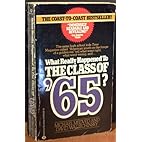
In 2025 I was surprised by What Really Happened to the Class of '65, by Michael Medved and David Wallechinsky.

 In 2025 I went to Secret Jacksonville: A Guide to the Weird, Wonderful, and Obscure, by Bill Delaney.

In 2025 I missed out on It All Makes Sense Now: Embrace Your ADHD Brain to Live a Creative and Colorful Life, by Meredith Carder.

In 2025, my family were Wild Things Are Happening: the Art of Maurice Sendak, edited by Jonathan Weinberg. 

In 2026, I hope it will be The Honeycomb, by Adela Rogers St. Johns.

We are what we read!


2026 Nonfiction Reader Challenge: I'm Gonna Do It!


 Shellyrae at Book'd Out is hosting  the 2026 Nonfiction Reader Challenge.  Since I so enjoyed Nonfiction November, I'm signing up for this one, in the form of a Nonfiction Grazer, the description of which is: "Read & review any nonfiction book. Set your own goal, or none at all, just share the nonfiction you read through the year."  The other forms of participation require choice each month of a book from 12 different specific categories, something I find too restrictive.  I'd rather be at liberty to read whatever attracts my attention.  I'm a maverick, an opinionated old lady, and a nonconformist.  The Nonfiction Grazer describes me well.  I'll read darn near anything!  Just let me be the one to choose what I'll read.

I prefer reading nonfiction, though I will also read fiction.  In fact, I'd be happy to also sign up for a fiction reading challenge.  As long as I can pick what I will be reading.  In the fiction category, please don't ask me to read romance!  Definitely not my cup of tea.

Onward!

Monday, December 22, 2025

Sunday Salon: The Last Few Days Before Christmas

 These last few days before Christmas my husband and I have been:

Wrapping Christmas presents and getting some in the mail.  The mail-out presents don't have far to go, just from here in north Florida to our friends Tom and Amanda in central Florida, and should arrive Wednesday.  Others are local.  Some have already been given, to our nephew Paul who visited us from Australia, where he lives.

Watching NFL football, particularly games in the AFC South conference.  Our team, the Jacksonville Jaguars, have been tearin' up the pea patch and finally getting some recognition.  We watched them beat the Denver Broncos yesterday, 34-20, after almost every prognosticator had predicted they'd lose.  Not the first time the Jaguars have been underrated against the Broncos.  The first time was 4 January 1997, when the Jaguars were dissed as "jagwads" by Denver sports writer Woody Paige.  That fired up the team enough that they won, 30-27.  The effect on the fans was electrifying, and we were among the throng who flocked to the stadium in the dark of night to welcome the team home.  Their airplane received permission to divert to a circle path over the stadium before landing at Jacksonville International Airport.  And when they arrived, and quarterback Mark Brunell said into the microphone, "Jacksonville, do you believe in miracles?" -- Pandemonium!

Reading.  I'm into a book titled Hillbilly Highway: The Transappalachian Migration and the Making of a White Working Class, by Max Fraser.  It was suggested by a newly-found distant cousin when I mentioned to her that my maternal ancestors had gone from eastern Tennessee, one location of our mutual roots, to Indiana.  Cousin Nancy suggested they may have been part of this migration.  I'm also reading, via Kindle, You Went to Emergency for WHAT?, a hilarious yet somewhat acerbic account by Australian paramedic Tom Booth of the ridiculous demands often made on hospital emergency departments.  

 Doing genealogy.  One way I'm hoping to preserve my family history and that of my husband is to contribute to the collaborative family tree at WikiTree, which is for genealogists by genealogists.  It strictly requires that members provide source citations to reliable sources, an aspect that I am 100% behind.  I've just ordered a book on how to see to it that one's family history is preserved after one has shuffled off this mortal coil.

Celebrating.  Our grandson Victor just turned 21, and we had a small family celebration.  He's in college now, and is planning on moving to North Carolina next year.

Next week, I think we'll spend most of our time recovering!

Happy Holidays to all!

#Sunday Salon 


Three Book Journals for Recording Your Reading

 As I grow older, and as I have ADHD, my memory is not so good these days.  For that reason, I look for ways to record my reading, so I can see what I've read in the last couple decades, and some from before that.  I like to go back and look at what I've already read.  I also use these book journals to be sure I don't buy a book I've already read years before!

I have, since the late 1990s, found three book journals for recording my reading.  Here are my reviews of them.

The first one I found is Bookography: The Journal and Journey of my Well-Read Life, from Levenger, a website for readers and writers, with all sorts of gadgets, paper, pens, and other items related to reading and writing (www.levenger.com).  This record is letter-sized (8.5 x 11).  It is bound with Levenger's clever disk binding, with a special hole-punch and disk arrangement, making the record ultimately flexible in the way you can arrange the pages.  That is a key to the use of this particular format.

There is an introduction, instructing the user on how to use this journal.  This format is divided into several sections: List of Candidates (books you want to read), Library of Candidates (your TBR or TRQ), Now Reading (what you're reading at the moment), Apres Reading (first reactions to having read the book), Living Library (those you've read, and liked, and wish to keep, perhaps to re-read), and Castaways (the ones you simply could not finish).  Each page, which is the record of the individual book, reflects these divisions.  As the user progresses through these stages with each book, he or she fills in the page, section by section.

 As the user fills in the page, he or she migrates the page through the divisions of the journal, which are marked by dividers.  Each page will find its final place in either the Living Library section, or among the Castaways.  Information recorded includes title, author, date acquired/read, why you want to read the book, how it fits into each of the divisions of the record, and any other aspect the user cares to mention.

For the way I operate, this format is confusing and cumbersome.  It is not easy to use, and therefore, I did not use it effectively.  It just doesn't fit my personal style.  One thing offputting to me is that, while the back of each page has ample note space for recording my reactions to a book, the format requires flipping back and forth from the front of the page, the starting place for notes on specific aspects of the book, to the back of the page for more space in which to continue to record these reactions.  It's a great idea, and may work for some people.  It just doesn't work for me.

The second format I encountered is one I picked up at a local independent bookseller.  It is Book Lover's Journal, produced by Cachet Products, Inc., of Fairfield, New Jersey.  They may not be in business any more.  This record is small, 5 inches by 8 inches.  There is little room to record a reaction to a book, and the front of the page is one individual record, and the back of the page is another record.  This forces each review to be too brief for my taste.

Information asked for on each record page is title, author, publisher, date, where bought or borrowed from, recommended by, date read, recommended to, subject, and comments.  My chief complaint, again, is the lack of enough space to write what I consider to be a good, informative, full review.

The third and last journal format is one more suited to my style.  It is the Premium Reading Journal, by Clever Fox.  I found this one on Amazon.com.  It is also smaller than the Levenger journal, this one being 5x8.  The accompanying material says this journal is of European manufacture.  The whole package is elegance itself: the journal is in book form, with a traditional binding.  It comes in a lovely little box that closes magnetically.  There is a brochure which describes in detail how to use this journal.  In the box is a ribbon, to be placed under the journal, for ease in lifting the journal out of the box!  That is elegance.  

For all that elegance, I found the price quite reasonable, and I'm a direct descendant of Massachusetts Puritans, with a strong streak of that penny-pinching New England thrift in my bones.  

The journal begins with an index.  The user writes the journal page number and the title of the book reviewed on that page.  The user can rate the book from one to five stars in the third column of the index.  Next is the To Be Read (TBR) list, where the user writes the title of the book in the first column, and, in the next three, records whether the book is a "want" or a "have," and whether the user finally got around to reading it.   Next is a section "to help you track your daily reading habit and ensure you regularly read all year long."  You get the sense that They're Watching You!  The user simply places a check mark in the box under each month and day.  

In the next section, the user records his or her favorite authors, with name, the user's favorite book or series by that author, other books in the series (if it is in a series), and what the user likes about the author's books.  The next two-page spread presents a reading challenge, where the user enters their selection under a variety of criteria, for example, a book by an author from a marginalized community, or a graphic novel.  Next, under Literary Highlights, the user can comment on such aspects of reading as the Most Unexpected Gem they found in their reading, or the Most Immersive Worldbuilding.  After that comes My Favorite Quotes, where the user can record bon mots from their reading, with the quotation, the book, the author, and the page number on which the quotation appears.

Then comes the list of books the user just could not force themselves to finish, giving the book, the author, the last page read, and the reason they stopped reading it.  Here's the place where the user can -- in a sentence or two -- let the author of dreck have it with both barrels.  One must have one's standards.

The comes the meat of the journal: the area where the user records each book they have read.  This section consists of two-page spreads for the user's reviews.  At the top of the left-hand page is a section for recording the basic information: author, title, genre, year published, number of pages, whether fiction or non-fiction, and format (book, audiobook, or e-book).  The user may also enter the date begun and the date finished, and may fill in a pie chart for rating the writing, characters, plot, readability, setting, and enjoyment, and can also indicate how many stars they give each book.  The pie chart is skewed toward fiction, but may also be used for non-fiction.  The segments of the pie chart are graduated, so the user can indicate how good or how bad each aspect on the pie chart seemed to them.  On the rest of the left-hand page, the user may record their first impressions of the book, how the book may have challenged their beliefs or ideas, and the key takeaway they'll remember about the book.  On the right-hand page is ample space for "Thoughts and Notes."  The layout of the two-page spread in this section means the user does not have to keep flipping the page back and forth to fill in everything.   This journal is definitely more suited to my style.

There certainly are other book journals out there, in a variety of formats.  I don't think I'll be looking anymore, unless it comes to pass that I can't get the Clever Fox journal anymore.  I'm probably going to have to buy one each year!

Happy reading!


Wednesday, November 26, 2025

Nonfiction November Week 5: My Choices from the Blog Posts

Oh, what a delicious smorgasbord of books we have been served this month!  It has been really difficult to winnow the offerings for the ones that appeal the most to me.  I've already bought one.  It's on my Kindle, ready to read.  Which one?  Read on. 

The others are on my Amazon.com wish list.  Christmas is a-comin' and the geese are gettin' fat . . . 

Here is the list of the books that made it onto my TBR, TRQ, or whatever you may want to call it.  I have seen that most of the other participants in this challenge use TBR (to be read, I presume).  A bunch of aspiring writers, some of whom have since been published (including me) I hung around with in cyberspace for some 30 years use TRQ (to-read queue).  It's all the same.  (Should I confess my TRQ would make a stack oh, I guess . . . six feet high?  H'mm.  I have some reading to do.) 

 1.  Come, Tell Me How You Live, by Agatha Christie.  Recommended by Mary Elizabeth at She Reads Novels.  I read just about everything Agatha Christie wrote when I was just a kid, encouraged by the example of my mother reading them.  I became a fan of mysteries.  I'm curious to learn what she was willing to reveal about herself.

2.  Elizabeth and Essex: A Tragic History, by Lytton Strachey, recommended at What? Me Read?  I'm rather intrigued by Elizabeth, and have a copy of Elizabeth I: Collected Works, her own writings.  I've known about Elizabeth and Essex for a long time, and have decided to read it.

3.  The Day the World Came to Town: 9/11 in Gander, Newfoundland by Jim DeFede, recommended by Deb at Reader Buzz.  I never have been much for daytime TV, so my television was off that awful morning.  My younger daughter drew my attention to the horror occurring in New York City when she called me from her workplace.  Later, when I learned of the wonderful support and hospitality shown to passengers on those diverted U.S.-bound airliners by the people of Gander, Newfoundland, I was eminently proud of being part Canadian.

4.  Banned Together: Our Fight for Readers' Rights, edited by Ashley Hope Perez, recommended by Anne at Head Full of Books.  As a former librarian, I have no use for book-banning, censorship, fools who rail against books they have NOT read, and other nonsense.   

5.  The Notebook: A History of Thinking on Paper by Roland Allen, recommended by Mark at Mark Joseph Jochim.  As a historian and a genealogist (retired), I'm a note-taker supreme.  I'm looking forward to reading this book.  I hope it will have some good tips for me. 

6.  The Ship Beneath the Ice by Mensun Bound, recommended by Angela at Musings of a Literary Wanderer. Among the many jobs I've had, and this one the best by far, I served 15 years in the U.S. Coast Guard, active duty and reserve, enlisted and officer.  Therefore, things of a maritime nature intrigue me.  I'm adding this story of the discovery of the wreck of Sir Ernest Shackleton's Antarctic exploration ship, Endurance.     

7.  The Year Without Summer: 1816 and the Volcano that Darkened the World and Changed History by William K. Klingaman and Nicholas P. Klingaman, recommended by Harry at Unsolicited Feedback. I expected this book was about Krakatoa, but the 1816 date told me I was wrong.  Tambora, a volcano in the Indonesian archipelago, exploded with more force and volume than Krakatoa and affected the weather around the world.  This is another must-read for me.

8.  Who Owns this Sentence: A History of Copyrights and Wrongs by David Bellos and Alexandre Montagu, recommended by Nicky at The Bibliophibian (isn't that a wonderful blog title!).  This appeals to the word nerd and writer in me. 

9.  Shakespeare: The Man Who Pays the Rent by Judi Dench, recommended by Annabel at AnnaBookBel.  I do like Dame Judi, and am looking forward to reading this book!

10.  Advice for Future Corpses (And Those Who Love Them): A Practical Perspective on Death and Dying by Sallie Tisdale, recommended by Lisa at Lisa Notes on Life &Love.  I've read a good deal on death and dying, as I was a registered nurse many years ago.  Also because I've had many losses over my lifetime, beginning with my father's passing in 1954, when I had just turned 7 years old. 

11. Being Mortal: Medicine And What Matters In The End by Atul Gawande recommended by Aj at Read All the Things. The author is an oncologist and surgeon; our younger daughter has cancer.  Rather than fear it, I choose to master it by learning all I can about it.  Our daughter has already mastered it, and I tell people she is not afraid of the cancer.  The cancer had better be afraid of her.

12.  And finally, the one I have already bought for my Kindle: You Went to Emergency for WHAT? by Tom Booth, recommended by Shellyrae at Book'd Out.  As a nurse, I worked for a while in a rather large city hospital's emergency room.  I hope this is as intriguing a read as it seems to be.

So there's the beginning of my nonfiction reading for next year.  See you in November, 2026.  And a good bit before, too, I hope.


Monday, November 17, 2025

Nonfiction November Week 4: Diverse perspectives

 We've passed the halfway mark in this challenge month.  Week 4 asks us which book we read this past year from a diverse author, or one that changed our perspectives.  The host this week is Rebekah at She Seeks Nonfiction. 

 I've done both. 

Diverse authors:  I picked George Takei, Japanese-American (nisei), reading his graphic novel They Called Us Enemy, about his family's experience being interned by the government during World War II.  I think he picked the graphic novel format to appeal to readers younger than I am, though the format has an immediacy that mere words cannot achieve, even for an old fogey like me.  We see the degradation these thousands upon thousands of loyal American citizens suffered, the indignity of being considered "enemy aliens."  Ever since I first learned about the internment, when I was in high school, it has been something I consider to have been offensive.  Do I not get the concept of "national security?"  Yes, I do, having served in the military and having taken a seminar in national defense taught by a retired Navy admiral with wide experience in the concept.  The mass labeling of people who don't deserve the label is offensive to me.  If there are a few security risks, concentrate on them.  Don't throw innocent and loyal folk into concentration camps.  War hysteria is a thing.  It is not a good thing.

For a book that changed my perspective, it is Five Days at Memorial: Life and Death in a Storm-Ravaged Hospital, by Sheri Fink.  Fink, a Pulitzer Prize-winning New York Times reporter, demonstrates the horrible lack of preparedness for Hurricane Katrina.  The subject hospital, in New Orleans during and after that storm, was cut off by flood waters.  Services -- electricity, supply, rescue -- were unavailable for a period during and after the storm.  Medications and other supplies were running out.  Patients who needed machines -- respirators, monitors, IV pumps -- had to depend on the failing generator capacity of the hospital.  Finally, the staff were presented with the extreme of triage, having literally to decide which patients could be saved and which could not.  Having been a registered nurse, I had to conclude that I don't know how I'd have reacted in such a situation.  But I think the staff made the only choice they could make, under those incredibly horrid circumstances.  Where lies the blame, if any is to be assessed?  I think it belongs to those who made paper promises of rescue and restoration, and failed miserably to keep them.  

Monday, November 10, 2025

Nonfiction November Week 3: Pairings

This week's hostess for Nonfiction November is Liz at Adventures in Reading, Running,and Working From Home.  The prompt:

This week, pair up a nonfiction book with a fiction title. Maybe it’s a historical novel and the real history in a nonfiction version, or a memoir and a novel, or a fiction book you’ve read and you would like recommendations for background reading. Or maybe it’s just two books you feel have a link, whatever they might be. You can be as creative as you like! 

I'm pairing books about art: a nonfiction bookNational Gallery of Art, Washington, D.C. by John Walker (New York: Harry N. Abrams, Inc., n.d.) and a fiction work, Water Studies, by Virginia Mann (Bretton Bay Books, 2017).  

First, a disclaimer:  Virginia Mann was my first cousin.  She and I had several years ago renewed contact via Facebook.  She died a few years ago, much to my sadness and regret.  She had a great career as an art historian and museum curator.  She had one last bucket list item just a few years before she passed: she wanted to write a novel.  And so she did.

The plot of Water Studies revolves around two mysterious artist's sketchbooks of a few hundred years' vintage, discovered in two very different places by two different women.  The investigation into the sketchbooks' origin and provenance reveals also the story of a family torn apart and then reunited.  Sprinkled among plot points are references from our own family's life.  One is a reference to one female family member's boyfriend half a century past, a young naval aviator in training at the Pensacola Naval Air Station.  This is a wonderful reference to my father, a fine tribute and heart-warming to me, as he died when I had just turned seven years old.  Another reference to one of the protagonists offering to teach the other hula, which she learned in Hawaii, is a nod to Virginia's mother, my aunt Sally, who learned the hula when Uncle Dick was stationed in Hawaii during World War II, and who taught hula when they returned to the mainland.

The author's knowledge of art shows through the story.  If you are familiar enough with the lore surrounding one particular artist, you may guess the identity of the creator of the mysterious sketchbooks.  If you do, it doesn't diminish the story, in my estimation.   

The nonfiction book I have chosen as a companion to this fiction work is a brief history of the National Gallery of Art.  Significant collections donated to the Gallery are described.  The book even includes maps of the floors of the building, marked with the themes of the works found therein.  The rest of the volume is composed of plates of important paintings in the Gallery's collections, with a description and history of each work.  Following that are several pages of small monochrome images of each painting described in the main body of the book.  Finally, there is a list of the illustrations.  

The author, John Walker, was the Director of the National Gallery from 1956 to 1968.


Monday, November 3, 2025

Nonfiction November: Week 2. A genre in which I haven't read?

Here it is week 2 of the Nonfiction November Challenge!  I'm so glad to see so many people reading so many interesting books!  This week's blog posting is hosted by Frances at The Volatile Rune.

Week 2 Prompt:

"There are many topics to choose from when looking for a nonfiction book.  For example:  Biography, Autobiography, Memoir, Travel, Health, Politics, History, Religion and Spirituality, Science, Art, Medicine, Gardening, Food, Business, Education, Music to name but a few.  Maybe use this week to  challenge yourself to pick a genre you wouldn’t normally read?   Or stick to what you usually like is also fine.  If you are a nonfiction genre newbie, did your choice encourage you to read more?" 

Is there a genre in which I haven't read?  I've read at least one book in the categories listed in the prompt, and I have to add genealogy and language to the list.  So instead of wracking my brain to try to come up with a category of nonfiction I've never read, here is a list of books, one in each category heretofore mentioned, that I have read.

Biography:  Walkin' Lawton, by John Dos Passos Coggin.  Lawton Chiles, Governor of Florida 1991-1998, campaigned by walking practically the entire state as a way of meeting Floridians of all socio-economic levels.  He was an excellent governor, a progressive.  His main concern was always the welfare and betterment of the people of Florida.  He died suddenly during his second term, an event that shocked and saddened us all.  John Dos Passos Coggin is the grandson of the acclaimed novelist John Dos Passos, known mainly for his trilogy, U.S.A.

Autobiography:  Straight Shooting, by Robert Stack, with Mark Evans.  Open this book and it is like walking into a Starbuck's and sitting down at a table with Robert Stack as he relates outrageously funny tales about his life.  He also was a library of inside information about Hollywood, as his mother knew a number of Hollywood notables and he grew up in the film capital's aura.  

Memoir:  The Honeycomb, by Adela Rogers St. Johns.  The author was a celebrated reporter, screenwriter, and novelist.  In this memoir, she recounts some of her journalistic and life adventures, including her encounter with the notorious publisher William Randolph Hearst.  I read this as a teenager, and it inspired me as a writer.

Travel:  Free Country: A Penniless Adventure the Length of Britain, by George Mahood.  Mahood and a friend began this unusual and madcap travelogue with nothing but their Union-jack patterned underpants.  They started walking in the south of England and accumulated what they needed along the way to the north of Scotland by the kindness of strangers -- clothing, shoes, food, transportation, lodging.  What they acquired and how makes for a fascinating and wonderful read!

Health:  The Art of Cooking for the Diabetic, by Mary Abbot Hess, LHD, MS, RD, FADA.  Type 2 Diabetes is our family curse: my mother and brother had it, my husband and I and our older daughter have it, my husband's sister and their father had it.  The 375 recipes in this book make an effort to be tasty, and include full nutrition information.  The last revision was in 1996, the one I bought when my mother's diabetes was diagnosed, so some of the information in the book may be out of date.   

Politics:  Jacksonville: The Consolidation Story from Civil Rights to the Jaguars, by James B. Crooks.  I grew up in Jacksonville and was a Government major at Florida State University when the vote on consolidating the city and county governments was taken.  Jacksonville's municipal problems had mushroomed, and Consolidation was offered as a remedy.  Here's one observer's take on how it came about and how it has fared since that 1968 vote.

History:   If it Takes All Summer: Martin Luther King, the KKK, and States' Rights in St. Augustine, 1964, by Dan R. Warren.  Warren was a Special Prosecutor appointed by Florida Governor Farris Bryant to investigate demonstrations and violence in St. Augustine.  1964 was the 400th Anniversary of the settlement of St. Augustine in 1564 by Pedro Menendez de Aviles.  The festivities were disrupted by violent reactions by white resistors to peaceful demonstrations by the once-again ignored black population of the city.  

 Religion: One Nation Under Gods: A History of the Mormon Religion, by Richard Abanes.  This often critical history is well documented, with over 100 pages of endnotes.  This faith, in which adherents do an incredible job of taking care of their own, has had its controversies and struggles.  Religion is at times a hot-button topic.  The reader must make up their own mind on this one, but it is an engrossing book.

Science: Geologic History of Florida: Major Events that Formed the Sunshine State, by Albert C. Hine.  I first read this book in pre-publication manuscript, as it was the textbook for the course I took in Florida geology at the University of South Florida St. Petersburg.  The well-illustrated finished text is an elegant story of the formation of Florida millions of years ago, and its current status and challenges. 

Art:  Florida's American Heritage River: Images from the St. Johns Region, by Mallory M. O'Connor and Gary Monroe.  Lavish illustrations trace a history of the St. Johns River, one of two navigable north-flowing rivers in the world (the other is the Nile) as portrayed by artists from a self-taught ex-employee with a grievance to such luminaries as Winslow Homer and Martin Johnson Heade.  Packed with intriguing facts you never knew, this is an elegant and engaging book that will have a permanent place on your shelves.

Medicine:  Quest for a Cure: the Public Hospital in Williamsburg, Virginia, 1773-1885, by Shomer S. Zwelling.  This slim volume published by the Colonial Williamsburg Foundation makes me awfully glad I was born in the 20th Century!   Williamsburg's public hospital was a mental institution, and medicine in regard to mental health was in its infancy during the period covered in this book.  Treatment of mental illness and treatment of patients (in the sense of how they were perceived and dealt with) could be, to us, horrifying.

Gardening:  Florida Home Grown 2: the Edible Landscape, by Tom MacCubbin.  I used to have a garden, and MacCubbin's book was one of my go-to tomes for Florida gardening, which is vastly different from gardening in the north.  So many gardening books are slanted toward the states north of us.  Tom MacCubbin saw a niche that needed covering, and he covered it well.  The edible landscape discusses not only garden plots, but also using fruits and veggies in landscaping -- veggies as a border, fruit trees for the yard -- such a very Florida thing to do. 

 Food:  Gulp: Adventures on the Alimentary Canal, by Mary Roach.  The story of our digestive tract is told with humor by science writer Roach, but you had better have a strong stomach to read it, as it gets into some of the grittiest of nitty-gritty details about digestion.  Don't eat before reading!

Business:  Professional Genealogy: A Manual for Researchers, Writers, Editors, Lecturers, and Librarians, edited by Elizabeth Shown Mills.  In this book is all an individual needs to set up and run a business offering professional genealogy services, from structuring the business to contracts to fees and recordkeeping.  Chapters are written by the top-tier professional genealogists, most of whom carry professional certification credentials.

 Education:  Self-University, by Charles D. Hayes.  Education is where you find it, in a dedicated institution or by your own design as an auto-didact.  I've done both, and enjoyed it.  Hayes dissects institutional education, the media, and other outside influences.  Then he builds on how one can educate oneself through knowledge and experience.  The book is skewed toward the workplace, and in that, at a certain level.  But the idea of designing one's own learning program can fit anyone.

Music: The American Songbag, by Carl Sandburg.  Noted American poet Carl Sandburg gathered American music from folk songs to torch songs to ethnic songs, including all eight verses of "La Cucaracha."  I have the 1990 edition, which includes an introduction by Garrison Keillor, of The Prairie Home Companion fame.  The book is divided into sections by type of song.  Brief explanatory notes give some information about the song -- its meaning, its origin.   

Language:  A Pleasure in Words, by Eugene T. Maleska.  Crossword-puzzle editor for the New York Times when he wrote this book, Maleska looks at the etymology of words, noting contributions to English from the Greeks and Romans, the French, the Spanish and Italians, and other ethnicities.  Contributions?  As James D. Nicoll has it, "English has pursued other languages down alleyways to beat them unconscious and rifle their pockets for vocabulary."

 Genealogy:  Only a Few Bones: A True Account of the Rolling Fork Tragedy and its Aftermath, by John Philip Coletta.  Colleta had a bit of family lore about an ancestor's death at Rolling Fork Landing in Mississippi in 1873.  He embarked on years of painstaking research, meticulously documented in the book, to tell the story and propose possible solutions to the mystery.  This is a textbook of genealogical research.

There you have it.  If you can think of a category I haven't covered here, let me know.  I just might have a book on my shelves that fits it!

 

Friday, October 31, 2025

Nonfiction November, Week 1

 For a variety of reasons I won't belabor, I've not posted in this blog for a very long time.  My apologies.

I have decided to participate in the Nonfiction November challenge, which has multiple hostesses.  This week's hostess blog is at  Based on a True Story. You can find more information here: She Seeks NonFiction.  Week One prompts:

"We’re glad to have you here. Let’s start with a review of the nonfiction books that you’ve read since this time last year.

  • What books have you read?
  • What were your favorites?
  • Is there a topic you want to read about more?
  • What are you hoping to get out of participating in Nonfiction November?"

 What books have I read in the past year?

We Carry Their Bones: the Search for Justice at the Dozier School for Boys, by Erin Kimmerle.  The author is a forensic anthropolgist and professor at the University of South Florida.  She led an expedition to uncover the truth about this infamous reformatory in north Florida, and found a horrific story, indeed.

What's Next: A Backstage Pass to The West Wing, its Cast and Crew, and its Enduring Legacy of Service, by Melissa Fitzgerald and Mary McCormack, with an introduction by Allison Janney and a foreword by Aaron Sorkin.  This is a wonderful and engaging backstage look at the television series The West Wing, a favorite of my husband and myself.  The authors had roles in the series.  Introduction author Allison Janney played the press secretary, C. J. Cregg.  The preface is by the series creator, Aaron Sorkin.  

 Wild Things Are Happening: the Art of Maurice Sendak, edited by Jonathan Weinberg.  This is an unusual work, consisting of a series of essays on various aspects of the work of the acclaimed children's book author and illustrator, my favorite.  I loved his work since I first encountered it in library school on my way to becoming a public librarian, in my coursework on children's literature.  My daughters loved it, too, when I read his books to them when they were little ones.  

Making it So: A Memoir, by Sir Patrick Stewart.  Stewart came to the U.S. as an unknown British Shakespearan Actor, as one critic characterized him at the time.  He came, of course, to play Captain Jean-Luc Picard in Star Trek: the Next Generation.   It's a wonderful read, and it feels like you're sitting down to an informal afternoon's tea with Sir Patrick as he lets it all hang out about his life and times.  

What Really Happened to the Class of '65, by Michael Medved and David Wallechinsky.  I read this book along with a former roommate as we research to write our own book about our own "class of '65," women with whom we shared housing at Florida State University in the late 1960s.  We were very different from the rich kids Medved and Wallechinsky wrote about.  

Secret Jacksonville: A Guide to the Weird, Wonderful, and Obscure, by Bill DelaneyI found an article on the web accusing Jacksonville, Florida, of being one of the most boring cities in the United States.  Phooey, says I, who grew up in Jacksonville; if you're bored in Jacksonville, you're not looking.  There's plenty to do here, and Bill Delaney's book tells about many of the attractions here.

It All Makes Sense Now: Embrace Your ADHD Brain to Live a Creative and Colorful Life, by Meredith Carder.  I have recently determined, with the help of my therapist, that I have ADHD.  In this book are tools I can use -- which I have never had before -- to help me cope with my ADHD and turn it to my advantage.  It is such a relief after 70 years of negative self-talk, wrestling with my emotions, and other difficulties, to find a way out of all that and into my better life.

Puritan Pedigrees: the Deep Roots of the Great Migration to New England, by Robert Charles Anderson. The Great Migration is the name given to the large-scale emigration of dissenters from England to the colony of Massachusetts from 1620 to 1640, of which my 8x great-grandfather, Samuel Packard, was a part.  Anderson, an accomplished and well-respected genealogist and historian, explains the background and composition of this migration. 

Five Days at Memorial: Life and Death in a Storm-Ravaged Hospital, by Sheri Fink.  Pulitzer-Prize winning New York Times reporter Fink writes the grisly history of a New Orleans hospital during and in the few days after Hurricane Katrina.  It is a difficult but important book to read. 

They Called Us Enemy, by George Takei.  Done in the style of a graphic novel, this true story of his family's internment in what was basically a concentration camp during World War II is one that needs to be told.  I have meet George Takei on at least two different occasions, at fan conventions in Florida.  He is warm and funny, but turns serious when talking about this childhood experience.  He bears no ill will, but wants to promote the idea of nondiscrimination and of viewing people as people, not categories. 

Jack Ruby: the Many Faces of Oswald's Assassin, by Danny Fingeroth.  I watched this individual gun down presidential assassin Lee Harvey Oswald on live national television that horrible weekend in 1963.  I was 16.  I've always had an interest in history, even the grubby parts.  Jack Ruby was one of the grubbiest parts of our national story, a low-level mob hanger-on and perfect patsy for someone who wanted to silence Oswald.  

 Will You Miss Me When I'm Gone: The Carter Family and their Legacy in American Music, by Mark Zwonitzer and Charles Hirshberg.  I have a dear friend who is a distant cousin of A. P. Carter, the famed songcatcher and composer of country music.  I have recently found that I'm a cousin of his sister-in-law Maybelle Addington Carter, the "Mother" of the Carter Family Singers.  Well-researched and well-written, with many illustrative photographs,  Will You Miss Me When I'm Gone is a touching and intimate family story, which became more personal when I learned of my kinship tie to them.

 Ten Percent of Nothing: The Case of the Literary Agent from Hell, by Jim Fisher.  Fisher, a former FBI agent and a professor of criminal justice, tells of a friend who got caught up in a fraudulent publishing scheme.  This happens all too often to aspiring writers looking to get published but having no knowledge or experience in how the industry works.


 Making It So: A MemoirWhat Really Happened to the Class of '65?Secret Jacksonville: A Guide to the Weird, Wonderful, and Obscure    

    They Called Us Enemy     

What were my favorites?

Among these thirteen books, my favorites were What's Next and Making it So.

Is there a topic you want to read about more?

Yes.  Right now, I want to read more about ADHD, as I am seeking a diagnosis so I may receive treatment, and so that I can definitely know what has ruled my life for 70 years.

What are you hoping to get out of Nonfiction November?

The opportunity to meet new people, new fellow readers.  The opportunity to read interesting new blog posts and find interesting books to read.  

Onward!


Friday, August 12, 2016

A Well-done Bad Guy

Right now, I'm reading Lisa M. Peppan's Sorry, No Refunds.  This is the second of the series she has named Geaehn Chronicles, telling the story of a magical realm named Gaeah, where mundane folk must contend with magic-users, some benign and some not.  The first in the series is Somewhen Over the Rain Clouds.  In that story, a group of off-duty Seattle cabdrivers get into an accident, and end up in Geaeh.  How they learn to cope in their new home is an engaging story, and of course, sets us up for this continuation of the series.  Tilli Kuru, the first character we meet in this second installment, is definitely not benign. 

I have read only one other book in which the bad guy is the first character we meet.  That book was the first in the Thomas Covenant series, written by Stephen R. Donaldson.  I read -- or, attempted to read -- the first in that series at the end of the 1980s or beginning of the 1990s.  I got only 100 pages into the book, to the part where Thomas Covenant, apparently one terribly messed-up person, rapes a woman who had only been trying to understand and help him.  That was it.  The book went against the wall (yes, I am a book-flinger), and I never darkened Donaldson's pages again. 

But not only was Thomas Covenant a character too rotten for me to ever want anything to do with, Donaldson was a terrible writer, in my rather demanding opinion.  His writing was turgid and repetitive.  He used the phrase "as though" so often, that if I had continued reading his books, and had deposited a nickel in my froggy bank for each time he used that phrase, I could have financed the college education I indulged in from 2007 to 2015, spanning two post-baccalaureate degrees (a double major) and a second master's degree.

How I even slogged through that first 100 pages, I do not know.  I put the book down several times, exasperated by the overblown prose.

Tilli Kuru does something similar to Thomas Covenant.  He is a magic-user of the most destructive and evil kind, one of those called in the realm of Geaeh the Yellow Wiqq.  He has kidnapped an innocent mundane woman, and raped and impregnated her, which was his intent.  He has a special magic, being immune to something which can cause great physical damage to other magic users (nope, not going to tell you what.  Read the book).  Having this immunity gives him great power, and he wants to breed a race of people with this immunity.

Told you he was a rotten person.

The difference is that Lisa handles this aspect very deftly.  In few words, well-chosen, she gets the point across with no ambiguity.  Her writing is clean and spare.  And Tulli Kuru is not psychologically messed up and weak.  He's purely bad, with a dream of power and control, convinced that it is his right to do whatever he wants with lesser mortals to accomplish his nefarious goals.  He isn't a despicable ingrate like Thomas Covenant.  I cannot abide ingrates.  Tulli is just plain bad.  And Lisa gets to the heart of things within the first few pages.  No slogging through 100 pages to find out how rotten the character is.  Bang!  You're there by page 2, and on from that into the story.  That's writing.

Now for the disclaimer:  I have known Lisa M. Peppan as a friend and fellow writer for (mumble, mumble) years.  Let's just say it's been a long, long time.  She has been working on the Geaeh stories for a long time, polishing and massaging.  We are both members of a private online writer's group that has been going since . . . well, since my now middle-aged daughters were in middle school!  Remember the old Bulletin Board Systems (BBS)?  Remember how excited we all were to go from 300 bits per second to a screaming 1200, and then to the incredible 2400?  Yeah, that long ago.

That's bits per second.  Not megabytes.  Bits.  Let that sink in.

Lisa is now nearly through writing the third of the Geaeh Chronicles.  If you're a fan of fantasy, and looking for something to read, buzz on over to Amazon.com and get started.

And now for a little "simple desultory Philippic," to borrow from Simon & Garfunkel:  I supppose I will no longer be reviewing on Amazon.com books by people I know and am friends with on Facebook.  Amazon.com has decided that this is a no-no.  They have insulted many of their reviewers, me included, by assuming that we are doing such reviews only to pump up our friends.  They are assuming that we are nothing but simple-minded fawning fangirls and boys, rather than serious readers who appreciate good writing (and don't appreciate bad).  So I will be reviewing books by people I know here on Autobiography of a Bookworm.  Maybe I'll put all my reviews here rather than on Amazon.  Originally, the requirement on Amazon has been that a review should be at least 20 words.  They have not enforced that, and "This is a real good book," the sort of thing I've seen too often over there, just is not a review, by any competent standards.


Saturday, July 16, 2016

Has it been Seven Months?

Time flies while we're having fun . . . or not.  Time has certainly flown since I made my last post, talking about the 2016 reading challenge.

I'm still working on Certeau's The Practice of Everyday Life.  Well, really, I've been avoiding working on it.

But it's been a productive avoidance. 

I have taken off the challenge list the following: 

A book recommended by your local librarian or bookseller.  I have to confess that it wasn't a personal recommendation, but a de facto one, as the book was prominently displayed at the main library in my county.  The book is Notorious RBG: the Life and Times of Ruth Bader Ginsburg.

RBG is awesome!  What a fascinating life, and what a fascinating career in and perspective on the law she has.  The book is unusual among biographies in its format, but I enjoyed the different approach taken by the authors, Irin Carmon and Shana Knizhnik.  I think the approach they selected, and the organization of their material, reflects well the tale of how RBG arrived at a career as a lawyer and became a justice on the Supreme Court.  The book is lavishly illustrated with photos of RBG, her husband, and her colleagues, and there are also brief analyses of some of her important cases and opinions.

In the category of A book published before you were born, I chose one I mentioned in my last post, Historical Sketches of Colonial Florida, by Richard L. Campbell, published in 1892.  A surprise to me was that it was more well-documented than most histories from that era, with a goodly number of footnotes.  The footnotes are not exactly in the format favored by the Chicago Manual of Style, which today's historians use, but they are there, and that is more than can be said for a lot of late 19th and early 20th century histories.

The coverage runs from 1528, and the early explorers, to the early 19th century, to the time when Florida became a territory of the U.S.  Scholarship since has brought out a lot more of the story, of course, and the author, as with those of most national histories published in the U.S. during that time, had an anglocentric slant.  Still, it is an interesting read for those who choose to study colonial Florida.

I have not limited myself to reading books in the categories of the 2016 Reading Challenge, however.

I just finished Rhonda M. Kohl's The Prairie Boys Go to War: the Fifth Illinois Cavalry, 1861-1865.  I do confess that I would not have read the book had I not been made aware by Ms. Kohl in an e-mail a few years ago that she was depending heavily on diaries and letters written by the soldiers, including the diary and some letters of my great-granduncle Thadeus B. Packard.  (Yes, there's only one d in Thadeus here).  Not only is this a fine regimental history, it is also the most powerful intimate examination I have yet seen of the daily lives of Civil War soldiers.  Those on both sides faced the same difficulties, and Ms. Kohl tells their story, mainly through their own words.  She describes well the diseases that took their toll, the interpersonal difficulties at times, and the sometimes less-than-stellar qualities of the officers who commanded these troops.  Her description of the arrogance and lawlessness of General George Armstrong Custer, whose punishments of misbehaving soldiers were clear violations of military regulations, might make some readers think that he got exactly what he deserved at the Little Big Horn.

I am nearly finished with a delightful history of reference books, You Could Look it Up: the Reference Shelf from Ancient Babylon to Wikipedia, by Jack Lynch, who is now the head of the Department of English at Rutgers University, Newark.  He tells the stories of the devising of some of the world's most famous, at least among scholars, reference books of all time.  In between the chapters where he examines these references in different classes, two at a time, he has what he styles "half-chapters" in some of which are found broader views of reference books in general, and some of which give delightful trivia about the creating of some of these works.  He also answered some questions I had about the reference works I use in my work, those being Spanish dictionaries from the 15th century onward, which have been digitized by the Spanish Royal Academy.  One of them, referred to as the Rosal, for its author, is in handwriting, not printed, from 1611.  From this book, I found out that the reason this dictionary is in script is that this handwritten manuscript is the only copy of this dictionary ever made.  It did not get into print.

On to more reading!

Tuesday, January 5, 2016

The 2016 Reading Challenge

This comes from the blog Modern Mrs. Darcy. The Reading Challenge asks you to read:

  • a book published this year
  • a book you can read in a day
  • a book you've been meaning to read
  • a book recommended by your local librarian or bookseller
  • a book you should have read in school
  • a book chosen for you by your spouse, partner, sibling, child, or BFF
  • a book published before you were born
  • a book that was banned at some point
  • a book you previously abandoned
  • a book you own but have never read
  • a book that intimidates you
  • a book you've already read at least once
I am off to a good start.  Right now, I'm reading a book one of my daughters gave me for Christmas, from my extensive Amazon wish list.  It's The Historian's Toolbox: A Student's Guide to the Theory and Craft of History.  Technically, I'm no longer a student, since I've finished my late-in-life collegiate studies, having received my Master of Liberal Arts in Florida Studies from the University of South Florida St. Petersburg just this past May.  However, we are all -- or should be -- lifelong students.  And we historians are constant, inveterate, and total students.  I'm enjoying the book.  It has given me information on aspects of history and historical study of which I was unaware.

I am also working on a book that intimidates me.  It is Michel de Certeau's The Practice of Everyday Life.  It's a theoretical work, and therefore it makes my head hurt.  But I'm slogging through it.  He speaks of everyday practices of everyday people.  I just wish he had used everyday language in which to do it!  I am getting something out of it, but probably not as much as is there, alas.  Highfalutin' language and theory always make my head hurt.

As to a book published this year, I'll have to hunt for one.  A book I can read in a day?  I may have a few of those on my shelves, but not very many.  Maybe one of Alexander McCall Smith's No. 1 Ladies' Detective Agency books.  I love those.  They're delightful.

I have a number of books I've been meaning to read, and for that I think I'll choose fiction.  I will read my friend Lisa Peppan's Somewhen Over the Rain Clouds.  Maybe tomorrow when I take my sister-in-law to the library I'll ask for a recommendation from the librarian.  I like mysteries, so I'll see what she may have to say of something in that field.  A book I should have read in school.  H'mm.  Heh.  Do I want my professors to possibly see this?  Well . . . Okay, I'll fess up.  Dr. Charles Clossman, now chair of the Department of History at the University of North Florida, forgive me.  I didn't read Jack Temple Kirby's The Mockingbird's Song: Ecological Landscapes of the South in class.  I will read it this year, as part of the challenge.

I have a lot of books published before I was born, even though I was born a long time ago!  They were printing by that time.  Gutenberg showed me an advance copy of his Bible!  Okay, kidding aside, as a historian, I have a lot of old books.  My college housemate (FSU, 1965-66) Judith West sent me a book she had held onto since childhood.  This book was published in 1892, and she thought that, as a Florida historian, I'd be interested.  Indeed I am.  The book is Historical Sketches of Colonial Florida, by Richard L. Campbell.  It deals mainly with what was called West Florida, of which Pensacola was the capital in Spanish times, while my studies are mainly of East Florida, of which St. Augustine was the capital.  However, I can certainly read it for Judith, and in honor of my mother, as both were raised in Pensacola.

I have rather a fetish for reading banned books.  It is a way to thumb my nose at the prudes and arrogant bluenoses who ban them.  I must have a banned book in my collection; at least one.  I will check the American Library Association's website for their banned books list.  The website discusses banned and "challenged" books.  I'm sure I can find something fascinating on their lists.

A book you previously abandoned.  That is a tough one.  Usually, when I abandon a book, it is because I just cannot proceed any further in it, for a variety of reasons.  These are the books that I may feel so disgusted at that I throw them against the wall.  I have done so in the past because of execrable writing, terrible plotting, and disgusting characters.  I will have to work on that one.

A book you own but have never read.  I have a few of those.  I shall just peruse my bookshelves and pick one.  To be announced.  A book you've already read at least once.  Oh, that could be such a pleasure, for I have books that I have so thoroughly enjoyed I have read them again and again.  Thomas P. F. Hoving's The King of the Confessors is probably number one on that list.  It is a wonderful story, full of intrigue, telling how Hoving tracked down the elusive Bury St. Edmonds Cross.  This artifact was lost for many years.  It is an elaborately carved cross and is stunningly beautiful.  I also immensely enjoyed E. J. Priz's Cosa Nosferatu:  Capone.  Ness.  Cthulhu.  Yes, you read that right.  It was such big fun!  (Note that on the website, accessible from the above link, the second quoted review, the one in red letters, is mine!)

So that is the challenge, and how I plan to meet it.  I'll comment on these books as I finish them, and tick them off the list.

Take up the challenge!  Read some good books!  After all, we have the whole year, right?