For a variety of reasons I won't belabor, I've not posted in this blog for a very long time. My apologies.
I have decided to participate in the Nonfiction November challenge, which has multiple hostesses. This week's hostess blog is at Based on a True Story. You can find more information here: She Seeks NonFiction. Week One prompts:
"We’re glad to have you here. Let’s start with a review of the nonfiction books that you’ve read since this time last year.
- What books have you read?
- What were your favorites?
- Is there a topic you want to read about more?
- What are you hoping to get out of participating in Nonfiction November?"
What books have I read in the past year?
We Carry Their Bones: the Search for Justice at the Dozier School for Boys, by Erin Kimmerle. The author is a forensic anthropolgist and professor at the University of South Florida. She led an expedition to uncover the truth about this infamous reformatory in north Florida, and found a horrific story, indeed.
What's Next: A Backstage Pass to The West Wing, its Cast and Crew, and its Enduring Legacy of Service, by Melissa Fitzgerald and Mary McCormack, with an introduction by Allison Janney and a foreword by Aaron Sorkin. This is a wonderful and engaging backstage look at the television series The West Wing, a favorite of my husband and myself. The authors had roles in the series. Introduction author Allison Janney played the press secretary, C. J. Cregg. The preface is by the series creator, Aaron Sorkin.
Wild Things Are Happening: the Art of Maurice Sendak, edited by Jonathan Weinberg. This is an unusual work, consisting of a series of essays on various aspects of the work of the acclaimed children's book author and illustrator, my favorite. I loved his work since I first encountered it in library school on my way to becoming a public librarian, in my coursework on children's literature. My daughters loved it, too, when I read his books to them when they were little ones.
Making it So: A Memoir, by Sir Patrick Stewart. Stewart came to the U.S. as an unknown British Shakespearan Actor, as one critic characterized him at the time. He came, of course, to play Captain Jean-Luc Picard in Star Trek: the Next Generation. It's a wonderful read, and it feels like you're sitting down to an informal afternoon's tea with Sir Patrick as he lets it all hang out about his life and times.
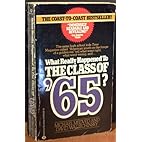
What Really Happened to the Class of '65, by Michael Medved and David Wallechinsky. I read this book along with a former roommate as we research to write our own book about our own "class of '65," women with whom we shared housing at Florida State University in the late 1960s. We were very different from the rich kids Medved and Wallechinsky wrote about.
Secret Jacksonville: A Guide to the Weird, Wonderful, and Obscure, by Bill Delaney. I found an article on the web accusing Jacksonville, Florida, of being one of the most boring cities in the United States. Phooey, says I, who grew up in Jacksonville; if you're bored in Jacksonville, you're not looking. There's plenty to do here, and Bill Delaney's book tells about many of the attractions here.
It All Makes Sense Now: Embrace Your ADHD Brain to Live a Creative and Colorful Life, by Meredith Carder. I have recently determined, with the help of my therapist, that I have ADHD. In this book are tools I can use -- which I have never had before -- to help me cope with my ADHD and turn it to my advantage. It is such a relief after 70 years of negative self-talk, wrestling with my emotions, and other difficulties, to find a way out of all that and into my better life.
Puritan Pedigrees: the Deep Roots of the Great Migration to New England, by Robert Charles Anderson. The Great Migration is the name given to the large-scale emigration of dissenters from England to the colony of Massachusetts from 1620 to 1640, of which my 8x great-grandfather, Samuel Packard, was a part. Anderson, an accomplished and well-respected genealogist and historian, explains the background and composition of this migration.
Five Days at Memorial: Life and Death in a Storm-Ravaged Hospital, by Sheri Fink. Pulitzer-Prize winning New York Times reporter Fink writes the grisly history of a New Orleans hospital during and in the few days after Hurricane Katrina. It is a difficult but important book to read.
They Called Us Enemy, by George Takei. Done in the style of a graphic novel, this true story of his family's internment in what was basically a concentration camp during World War II is one that needs to be told. I have meet George Takei on at least two different occasions, at fan conventions in Florida. He is warm and funny, but turns serious when talking about this childhood experience. He bears no ill will, but wants to promote the idea of nondiscrimination and of viewing people as people, not categories.
Jack Ruby: the Many Faces of Oswald's Assassin, by Danny Fingeroth. I watched this individual gun down presidential assassin Lee Harvey Oswald on live national television that horrible weekend in 1963. I was 16. I've always had an interest in history, even the grubby parts. Jack Ruby was one of the grubbiest parts of our national story, a low-level mob hanger-on and perfect patsy for someone who wanted to silence Oswald.
Will You Miss Me When I'm Gone: The Carter Family and their Legacy in American Music, by Mark Zwonitzer and Charles Hirshberg. I have a dear friend who is a distant cousin of A. P. Carter, the famed songcatcher and composer of country music. I have recently found that I'm a cousin of his sister-in-law Maybelle Addington Carter, the "Mother" of the Carter Family Singers. Well-researched and well-written, with many illustrative photographs, Will You Miss Me When I'm Gone is a touching and intimate family story, which became more personal when I learned of my kinship tie to them.
Ten Percent of Nothing: The Case of the Literary Agent from Hell, by Jim Fisher. Fisher, a former FBI agent and a professor of criminal justice, tells of a friend who got caught up in a fraudulent publishing scheme. This happens all too often to aspiring writers looking to get published but having no knowledge or experience in how the industry works.




What were my favorites?
Among these thirteen books, my favorites were What's Next and Making it So.
Is there a topic you want to read about more?
Yes. Right now, I want to read more about ADHD, as I am seeking a diagnosis so I may receive treatment, and so that I can definitely know what has ruled my life for 70 years.
What are you hoping to get out of Nonfiction November?
The opportunity to meet new people, new fellow readers. The opportunity to read interesting new blog posts and find interesting books to read.
Onward!

