A. Bookworm was born in Reading, Pennsylvania, son of B. A. Bookworm and Ima (Reeder) Bookworm. Ima was the daughter of Oral Reeder and Bea (Lector) Reeder. Bea was the daughter of Merry (Binder) Lector. The family does not speak of Bea's father, Hannibal Lector. It's a Grimm story.
Showing posts with label Nonfiction November Challenge. Show all posts

Wednesday, November 26, 2025

Nonfiction November Week 5: My Choices from the Blog Posts

Oh, what a delicious smorgasbord of books we have been served this month!  It has been really difficult to winnow the offerings for the ones that appeal the most to me.  I've already bought one.  It's on my Kindle, ready to read.  Which one?  Read on. 

The others are on my Amazon.com wish list.  Christmas is a-comin' and the geese are gettin' fat . . . 

Here is the list of the books that made it onto my TBR, TRQ, or whatever you may want to call it.  I have seen that most of the other participants in this challenge use TBR (to be read, I presume).  A bunch of aspiring writers, some of whom have since been published (including me) I hung around with in cyberspace for some 30 years use TRQ (to-read queue).  It's all the same.  (Should I confess my TRQ would make a stack oh, I guess . . . six feet high?  H'mm.  I have some reading to do.) 

 1.  Come, Tell Me How You Live, by Agatha Christie.  Recommended by Mary Elizabeth at She Reads Novels.  I read just about everything Agatha Christie wrote when I was just a kid, encouraged by the example of my mother reading them.  I became a fan of mysteries.  I'm curious to learn what she was willing to reveal about herself.

2.  Elizabeth and Essex: A Tragic History, by Lytton Strachey, recommended at What? Me Read?  I'm rather intrigued by Elizabeth, and have a copy of Elizabeth I: Collected Works, her own writings.  I've known about Elizabeth and Essex for a long time, and have decided to read it.

3.  The Day the World Came to Town: 9/11 in Gander, Newfoundland by Jim DeFede, recommended by Deb at Reader Buzz.  I never have been much for daytime TV, so my television was off that awful morning.  My younger daughter drew my attention to the horror occurring in New York City when she called me from her workplace.  Later, when I learned of the wonderful support and hospitality shown to passengers on those diverted U.S.-bound airliners by the people of Gander, Newfoundland, I was eminently proud of being part Canadian.

4.  Banned Together: Our Fight for Readers' Rights, edited by Ashley Hope Perez, recommended by Anne at Head Full of Books.  As a former librarian, I have no use for book-banning, censorship, fools who rail against books they have NOT read, and other nonsense.   

5.  The Notebook: A History of Thinking on Paper by Roland Allen, recommended by Mark at Mark Joseph Jochim.  As a historian and a genealogist (retired), I'm a note-taker supreme.  I'm looking forward to reading this book.  I hope it will have some good tips for me. 

6.  The Ship Beneath the Ice by Mensun Bound, recommended by Angela at Musings of a Literary Wanderer. Among the many jobs I've had, and this one the best by far, I served 15 years in the U.S. Coast Guard, active duty and reserve, enlisted and officer.  Therefore, things of a maritime nature intrigue me.  I'm adding this story of the discovery of the wreck of Sir Ernest Shackleton's Antarctic exploration ship, Endurance.     

7.  The Year Without Summer: 1816 and the Volcano that Darkened the World and Changed History by William K. Klingaman and Nicholas P. Klingaman, recommended by Harry at Unsolicited Feedback. I expected this book was about Krakatoa, but the 1816 date told me I was wrong.  Tambora, a volcano in the Indonesian archipelago, exploded with more force and volume than Krakatoa and affected the weather around the world.  This is another must-read for me.

8.  Who Owns this Sentence: A History of Copyrights and Wrongs by David Bellos and Alexandre Montagu, recommended by Nicky at The Bibliophibian (isn't that a wonderful blog title!).  This appeals to the word nerd and writer in me. 

9.  Shakespeare: The Man Who Pays the Rent by Judi Dench, recommended by Annabel at AnnaBookBel.  I do like Dame Judi, and am looking forward to reading this book!

10.  Advice for Future Corpses (And Those Who Love Them): A Practical Perspective on Death and Dying by Sallie Tisdale, recommended by Lisa at Lisa Notes on Life &Love.  I've read a good deal on death and dying, as I was a registered nurse many years ago.  Also because I've had many losses over my lifetime, beginning with my father's passing in 1954, when I had just turned 7 years old. 

11. Being Mortal: Medicine And What Matters In The End by Atul Gawande recommended by Aj at Read All the Things. The author is an oncologist and surgeon; our younger daughter has cancer.  Rather than fear it, I choose to master it by learning all I can about it.  Our daughter has already mastered it, and I tell people she is not afraid of the cancer.  The cancer had better be afraid of her.

12.  And finally, the one I have already bought for my Kindle: You Went to Emergency for WHAT? by Tom Booth, recommended by Shellyrae at Book'd Out.  As a nurse, I worked for a while in a rather large city hospital's emergency room.  I hope this is as intriguing a read as it seems to be.

So there's the beginning of my nonfiction reading for next year.  See you in November, 2026.  And a good bit before, too, I hope.


Monday, November 3, 2025

Nonfiction November: Week 2. A genre in which I haven't read?

Here it is week 2 of the Nonfiction November Challenge!  I'm so glad to see so many people reading so many interesting books!  This week's blog posting is hosted by Frances at The Volatile Rune.

Week 2 Prompt:

"There are many topics to choose from when looking for a nonfiction book.  For example:  Biography, Autobiography, Memoir, Travel, Health, Politics, History, Religion and Spirituality, Science, Art, Medicine, Gardening, Food, Business, Education, Music to name but a few.  Maybe use this week to  challenge yourself to pick a genre you wouldn’t normally read?   Or stick to what you usually like is also fine.  If you are a nonfiction genre newbie, did your choice encourage you to read more?" 

Is there a genre in which I haven't read?  I've read at least one book in the categories listed in the prompt, and I have to add genealogy and language to the list.  So instead of wracking my brain to try to come up with a category of nonfiction I've never read, here is a list of books, one in each category heretofore mentioned, that I have read.

Biography:  Walkin' Lawton, by John Dos Passos Coggin.  Lawton Chiles, Governor of Florida 1991-1998, campaigned by walking practically the entire state as a way of meeting Floridians of all socio-economic levels.  He was an excellent governor, a progressive.  His main concern was always the welfare and betterment of the people of Florida.  He died suddenly during his second term, an event that shocked and saddened us all.  John Dos Passos Coggin is the grandson of the acclaimed novelist John Dos Passos, known mainly for his trilogy, U.S.A.

Autobiography:  Straight Shooting, by Robert Stack, with Mark Evans.  Open this book and it is like walking into a Starbuck's and sitting down at a table with Robert Stack as he relates outrageously funny tales about his life.  He also was a library of inside information about Hollywood, as his mother knew a number of Hollywood notables and he grew up in the film capital's aura.  

Memoir:  The Honeycomb, by Adela Rogers St. Johns.  The author was a celebrated reporter, screenwriter, and novelist.  In this memoir, she recounts some of her journalistic and life adventures, including her encounter with the notorious publisher William Randolph Hearst.  I read this as a teenager, and it inspired me as a writer.

Travel:  Free Country: A Penniless Adventure the Length of Britain, by George Mahood.  Mahood and a friend began this unusual and madcap travelogue with nothing but their Union-jack patterned underpants.  They started walking in the south of England and accumulated what they needed along the way to the north of Scotland by the kindness of strangers -- clothing, shoes, food, transportation, lodging.  What they acquired and how makes for a fascinating and wonderful read!

Health:  The Art of Cooking for the Diabetic, by Mary Abbot Hess, LHD, MS, RD, FADA.  Type 2 Diabetes is our family curse: my mother and brother had it, my husband and I and our older daughter have it, my husband's sister and their father had it.  The 375 recipes in this book make an effort to be tasty, and include full nutrition information.  The last revision was in 1996, the one I bought when my mother's diabetes was diagnosed, so some of the information in the book may be out of date.   

Politics:  Jacksonville: The Consolidation Story from Civil Rights to the Jaguars, by James B. Crooks.  I grew up in Jacksonville and was a Government major at Florida State University when the vote on consolidating the city and county governments was taken.  Jacksonville's municipal problems had mushroomed, and Consolidation was offered as a remedy.  Here's one observer's take on how it came about and how it has fared since that 1968 vote.

History:   If it Takes All Summer: Martin Luther King, the KKK, and States' Rights in St. Augustine, 1964, by Dan R. Warren.  Warren was a Special Prosecutor appointed by Florida Governor Farris Bryant to investigate demonstrations and violence in St. Augustine.  1964 was the 400th Anniversary of the settlement of St. Augustine in 1564 by Pedro Menendez de Aviles.  The festivities were disrupted by violent reactions by white resistors to peaceful demonstrations by the once-again ignored black population of the city.  

 Religion: One Nation Under Gods: A History of the Mormon Religion, by Richard Abanes.  This often critical history is well documented, with over 100 pages of endnotes.  This faith, in which adherents do an incredible job of taking care of their own, has had its controversies and struggles.  Religion is at times a hot-button topic.  The reader must make up their own mind on this one, but it is an engrossing book.

Science: Geologic History of Florida: Major Events that Formed the Sunshine State, by Albert C. Hine.  I first read this book in pre-publication manuscript, as it was the textbook for the course I took in Florida geology at the University of South Florida St. Petersburg.  The well-illustrated finished text is an elegant story of the formation of Florida millions of years ago, and its current status and challenges. 

Art:  Florida's American Heritage River: Images from the St. Johns Region, by Mallory M. O'Connor and Gary Monroe.  Lavish illustrations trace a history of the St. Johns River, one of two navigable north-flowing rivers in the world (the other is the Nile) as portrayed by artists from a self-taught ex-employee with a grievance to such luminaries as Winslow Homer and Martin Johnson Heade.  Packed with intriguing facts you never knew, this is an elegant and engaging book that will have a permanent place on your shelves.

Medicine:  Quest for a Cure: the Public Hospital in Williamsburg, Virginia, 1773-1885, by Shomer S. Zwelling.  This slim volume published by the Colonial Williamsburg Foundation makes me awfully glad I was born in the 20th Century!   Williamsburg's public hospital was a mental institution, and medicine in regard to mental health was in its infancy during the period covered in this book.  Treatment of mental illness and treatment of patients (in the sense of how they were perceived and dealt with) could be, to us, horrifying.

Gardening:  Florida Home Grown 2: the Edible Landscape, by Tom MacCubbin.  I used to have a garden, and MacCubbin's book was one of my go-to tomes for Florida gardening, which is vastly different from gardening in the north.  So many gardening books are slanted toward the states north of us.  Tom MacCubbin saw a niche that needed covering, and he covered it well.  The edible landscape discusses not only garden plots, but also using fruits and veggies in landscaping -- veggies as a border, fruit trees for the yard -- such a very Florida thing to do. 

 Food:  Gulp: Adventures on the Alimentary Canal, by Mary Roach.  The story of our digestive tract is told with humor by science writer Roach, but you had better have a strong stomach to read it, as it gets into some of the grittiest of nitty-gritty details about digestion.  Don't eat before reading!

Business:  Professional Genealogy: A Manual for Researchers, Writers, Editors, Lecturers, and Librarians, edited by Elizabeth Shown Mills.  In this book is all an individual needs to set up and run a business offering professional genealogy services, from structuring the business to contracts to fees and recordkeeping.  Chapters are written by the top-tier professional genealogists, most of whom carry professional certification credentials.

 Education:  Self-University, by Charles D. Hayes.  Education is where you find it, in a dedicated institution or by your own design as an auto-didact.  I've done both, and enjoyed it.  Hayes dissects institutional education, the media, and other outside influences.  Then he builds on how one can educate oneself through knowledge and experience.  The book is skewed toward the workplace, and in that, at a certain level.  But the idea of designing one's own learning program can fit anyone.

Music: The American Songbag, by Carl Sandburg.  Noted American poet Carl Sandburg gathered American music from folk songs to torch songs to ethnic songs, including all eight verses of "La Cucaracha."  I have the 1990 edition, which includes an introduction by Garrison Keillor, of The Prairie Home Companion fame.  The book is divided into sections by type of song.  Brief explanatory notes give some information about the song -- its meaning, its origin.   

Language:  A Pleasure in Words, by Eugene T. Maleska.  Crossword-puzzle editor for the New York Times when he wrote this book, Maleska looks at the etymology of words, noting contributions to English from the Greeks and Romans, the French, the Spanish and Italians, and other ethnicities.  Contributions?  As James D. Nicoll has it, "English has pursued other languages down alleyways to beat them unconscious and rifle their pockets for vocabulary."

 Genealogy:  Only a Few Bones: A True Account of the Rolling Fork Tragedy and its Aftermath, by John Philip Coletta.  Colleta had a bit of family lore about an ancestor's death at Rolling Fork Landing in Mississippi in 1873.  He embarked on years of painstaking research, meticulously documented in the book, to tell the story and propose possible solutions to the mystery.  This is a textbook of genealogical research.

There you have it.  If you can think of a category I haven't covered here, let me know.  I just might have a book on my shelves that fits it!


Friday, October 31, 2025

Nonfiction November, Week 1

 For a variety of reasons I won't belabor, I've not posted in this blog for a very long time.  My apologies.

I have decided to participate in the Nonfiction November challenge, which has multiple hostesses.  This week's hostess blog is at  Based on a True Story. You can find more information here: She Seeks NonFiction.  Week One prompts:

"We’re glad to have you here. Let’s start with a review of the nonfiction books that you’ve read since this time last year.

  • What books have you read?
  • What were your favorites?
  • Is there a topic you want to read about more?
  • What are you hoping to get out of participating in Nonfiction November?"

 What books have I read in the past year?

We Carry Their Bones: the Search for Justice at the Dozier School for Boys, by Erin Kimmerle.  The author is a forensic anthropolgist and professor at the University of South Florida.  She led an expedition to uncover the truth about this infamous reformatory in north Florida, and found a horrific story, indeed.

What's Next: A Backstage Pass to The West Wing, its Cast and Crew, and its Enduring Legacy of Service, by Melissa Fitzgerald and Mary McCormack, with an introduction by Allison Janney and a foreword by Aaron Sorkin.  This is a wonderful and engaging backstage look at the television series The West Wing, a favorite of my husband and myself.  The authors had roles in the series.  Introduction author Allison Janney played the press secretary, C. J. Cregg.  The preface is by the series creator, Aaron Sorkin.  

 Wild Things Are Happening: the Art of Maurice Sendak, edited by Jonathan Weinberg.  This is an unusual work, consisting of a series of essays on various aspects of the work of the acclaimed children's book author and illustrator, my favorite.  I loved his work since I first encountered it in library school on my way to becoming a public librarian, in my coursework on children's literature.  My daughters loved it, too, when I read his books to them when they were little ones.  

Making it So: A Memoir, by Sir Patrick Stewart.  Stewart came to the U.S. as an unknown British Shakespearan Actor, as one critic characterized him at the time.  He came, of course, to play Captain Jean-Luc Picard in Star Trek: the Next Generation.   It's a wonderful read, and it feels like you're sitting down to an informal afternoon's tea with Sir Patrick as he lets it all hang out about his life and times.  

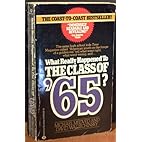
What Really Happened to the Class of '65, by Michael Medved and David Wallechinsky.  I read this book along with a former roommate as we research to write our own book about our own "class of '65," women with whom we shared housing at Florida State University in the late 1960s.  We were very different from the rich kids Medved and Wallechinsky wrote about.  

Secret Jacksonville: A Guide to the Weird, Wonderful, and Obscure, by Bill DelaneyI found an article on the web accusing Jacksonville, Florida, of being one of the most boring cities in the United States.  Phooey, says I, who grew up in Jacksonville; if you're bored in Jacksonville, you're not looking.  There's plenty to do here, and Bill Delaney's book tells about many of the attractions here.

It All Makes Sense Now: Embrace Your ADHD Brain to Live a Creative and Colorful Life, by Meredith Carder.  I have recently determined, with the help of my therapist, that I have ADHD.  In this book are tools I can use -- which I have never had before -- to help me cope with my ADHD and turn it to my advantage.  It is such a relief after 70 years of negative self-talk, wrestling with my emotions, and other difficulties, to find a way out of all that and into my better life.

Puritan Pedigrees: the Deep Roots of the Great Migration to New England, by Robert Charles Anderson. The Great Migration is the name given to the large-scale emigration of dissenters from England to the colony of Massachusetts from 1620 to 1640, of which my 8x great-grandfather, Samuel Packard, was a part.  Anderson, an accomplished and well-respected genealogist and historian, explains the background and composition of this migration. 

Five Days at Memorial: Life and Death in a Storm-Ravaged Hospital, by Sheri Fink.  Pulitzer-Prize winning New York Times reporter Fink writes the grisly history of a New Orleans hospital during and in the few days after Hurricane Katrina.  It is a difficult but important book to read. 

They Called Us Enemy, by George Takei.  Done in the style of a graphic novel, this true story of his family's internment in what was basically a concentration camp during World War II is one that needs to be told.  I have meet George Takei on at least two different occasions, at fan conventions in Florida.  He is warm and funny, but turns serious when talking about this childhood experience.  He bears no ill will, but wants to promote the idea of nondiscrimination and of viewing people as people, not categories. 

Jack Ruby: the Many Faces of Oswald's Assassin, by Danny Fingeroth.  I watched this individual gun down presidential assassin Lee Harvey Oswald on live national television that horrible weekend in 1963.  I was 16.  I've always had an interest in history, even the grubby parts.  Jack Ruby was one of the grubbiest parts of our national story, a low-level mob hanger-on and perfect patsy for someone who wanted to silence Oswald.  

 Will You Miss Me When I'm Gone: The Carter Family and their Legacy in American Music, by Mark Zwonitzer and Charles Hirshberg.  I have a dear friend who is a distant cousin of A. P. Carter, the famed songcatcher and composer of country music.  I have recently found that I'm a cousin of his sister-in-law Maybelle Addington Carter, the "Mother" of the Carter Family Singers.  Well-researched and well-written, with many illustrative photographs,  Will You Miss Me When I'm Gone is a touching and intimate family story, which became more personal when I learned of my kinship tie to them.

 Ten Percent of Nothing: The Case of the Literary Agent from Hell, by Jim Fisher.  Fisher, a former FBI agent and a professor of criminal justice, tells of a friend who got caught up in a fraudulent publishing scheme.  This happens all too often to aspiring writers looking to get published but having no knowledge or experience in how the industry works.


 Making It So: A MemoirWhat Really Happened to the Class of '65?Secret Jacksonville: A Guide to the Weird, Wonderful, and Obscure    

    They Called Us Enemy     

What were my favorites?

Among these thirteen books, my favorites were What's Next and Making it So.

Is there a topic you want to read about more?

Yes.  Right now, I want to read more about ADHD, as I am seeking a diagnosis so I may receive treatment, and so that I can definitely know what has ruled my life for 70 years.

What are you hoping to get out of Nonfiction November?

The opportunity to meet new people, new fellow readers.  The opportunity to read interesting new blog posts and find interesting books to read.  

Onward!